Straight teeth are no longer a choice between metal or nothing. Most people exploring orthodontic treatment today end up comparing two options: invisible aligners and traditional metal braces. Both can create a healthy, well-aligned smile, yet they work in very different ways and suit very different lifestyles. Picking the wrong one can mean slower progress, extra cost or a result that does not last.
This guide explains the seven differences that actually matter, using findings from published orthodontic research rather than marketing claims. Whether you are a working professional in Calicut, a parent planning treatment for a teenager, or an NRI visiting home for a short window through our international patient programme, you will find a clear answer here.
Invisible Aligners vs Metal Braces at a Glance
| Factor | Invisible Aligners | Metal Braces |
| Appearance | Nearly invisible clear trays | Visible steel brackets and wires |
| Removable | Yes, for eating and brushing | No, fixed throughout treatment |
| Daily wear | 20 to 22 hours, patient-controlled | 24 hours, works automatically |
| Comfort | Smooth plastic, milder early soreness | Brackets may rub cheeks and lips |
| Food rules | Eat anything once trays are out | Avoid hard, sticky and chewy foods |
| Best suited for | Mild to moderate cases | Mild to severe and complex cases |
| Clinic visits | Every 6 to 10 weeks, typically | Every 4 to 6 weeks for adjustments |
| Typical cost in India | ₹50,000 to ₹3,50,000+ | ₹25,000 to ₹70,000 |
1. Appearance: How Visible Is Each Option?
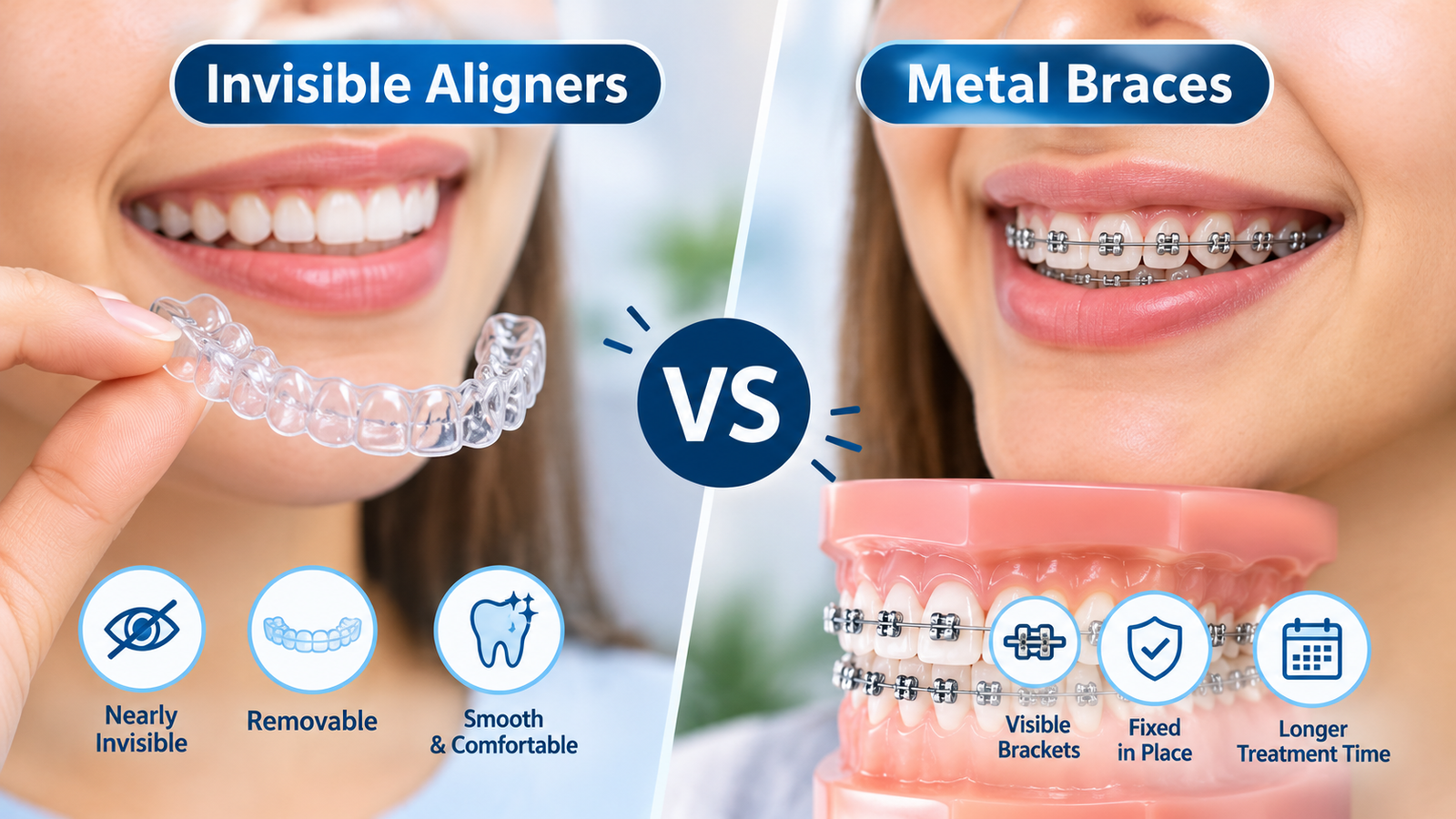
The most obvious difference is how each option looks. Invisible aligners are made from thin, transparent medical-grade plastic that hugs the teeth closely, so most people will not notice them during a conversation, a meeting or a wedding photo. Small tooth-coloured bumps called attachments are sometimes bonded to a few teeth to help the trays grip, but these blend in well.
Metal braces use stainless steel brackets glued to each tooth and joined by an archwire. They are clearly visible, although modern brackets are smaller and smoother than those of a decade ago, and coloured elastics make them a fun choice for many children and teens. If the look of metal is your main concern but you still need a fixed appliance, ceramic braces offer a middle path with tooth-coloured brackets.
2. Removability: How Does Each Fit Into Daily Life?
Aligners are removable, and this single feature shapes daily life more than any other. You take the trays out to eat, to drink anything other than plain water, and to brush and floss. That means there is no list of banned foods. Biryani, porotta, halwa and crunchy banana chips are all fine, as long as you brush before putting the trays back in.
The trade-off is responsibility. Aligners only move teeth while they are in your mouth, so orthodontists ask for 20 to 22 hours of wear every day. Leaving them in a drawer for an afternoon slows progress, and repeated lapses can push treatment off track.
Braces remove that decision entirely because they are fixed and always working. In exchange, patients must avoid foods that can damage the appliance:
- Hard foods such as nuts, ice cubes and hard toffees can snap brackets loose.
- Sticky foods like chewing gum, caramel and toffee cling to wires and trap plaque.
- Biting straight into whole apples or corn on the cob can bend the archwire.
3. Comfort: Are Aligners Less Painful Than Braces?
Every orthodontic treatment involves some pressure, because teeth have to move through bone. The real question is how much discomfort you feel and for how long. Research gives aligners an edge here. A 2026 meta-analysis published in BDJ Open found that aligner patients reported less pain than those with fixed appliances, especially in the early phase of treatment. An earlier systematic review in Progress in Orthodontics reached a similar conclusion, with the difference showing in the first days of treatment and disappearing afterwards.
Braces also bring a mechanical source of irritation. Brackets and wire ends can rub against the cheeks and lips, causing small ulcers until the soft tissues adapt, and each tightening visit brings a few sore days. Aligners have smooth edges and apply gentle, pre-planned force with each new tray, so most people describe the feeling as pressure rather than pain.
4. Oral Hygiene: Which Is Better for Your Teeth and Gums?
Cleaning is far easier with aligners because you simply remove them and brush and floss normally. With braces, food and plaque collect around every bracket and under the wire, so cleaning takes longer and often needs interdental brushes or a water flosser. Poor hygiene during braces can leave chalky white spots on the enamel once the brackets come off, along with swollen gums and bad breath.
The research leans towards aligners but is not one-sided. The BDJ Open meta-analysis reported more favourable periodontal indices in aligner patients. However, an umbrella review of four meta-analyses concluded that the impact of the two treatments on gum health should be considered comparable. In practice, your habits matter more than your appliance. Aligner wearers also have an extra task: cleaning the trays and removing them before tea or coffee to avoid yellowing and stains. Whichever option you choose, follow these 10 ways to keep your teeth healthy and keep up regular gum care check-ups.
5. Effectiveness: Can Aligners Fix Complex Cases?
This is the difference most comparison articles skip, yet it matters most for your final result. Metal braces give the orthodontist direct, continuous control over every tooth in three dimensions. That makes them the more predictable choice for severe crowding, large rotations, deep bites, open bites, jaw discrepancies and cases that need extractions.
Aligners have improved enormously, and in experienced hands they treat a wide range of problems. Still, the evidence shows real limits. A systematic review and meta-analysis in BMC Oral Health found that aligners performed well in segmented tooth movement and shortened treatment time, but were less effective than braces at producing proper bite contacts, controlling tooth torque and maintaining results. A later overview of systematic reviews also found more relapse with aligners, although periodontal health was better and root resorption risk tended to be lower.
- Aligners typically suit mild to moderate crowding and small gaps between front teeth.
- Aligners also work well for adults whose teeth shifted after earlier orthodontic treatment.
- Braces typically suit severe crowding, badly rotated teeth and cases requiring tooth extractions.
- Braces also suit major bite problems and children who may not wear removable trays reliably.
6. Treatment Time: Which Option Is Faster?
For mild to moderate cases, aligners are often quicker. The same BMC Oral Health meta-analysis found that aligner patients had a significantly shorter treatment duration than braces patients. Keep in mind that aligner studies tend to include simpler cases, so a complex case will take time with either method. As a general guide, many mild aligner cases finish in 6 to 12 months, moderate cases in 12 to 18 months, and braces commonly take 18 to 24 months.
Clinic visits also differ. Braces need adjustment appointments every four to six weeks, plus emergency visits for broken brackets or poking wires. Aligner patients receive several sets of trays at once, switch to a new set at home every one to two weeks, and come in for progress checks less often. At Amend, the gap from digital scan to receiving aligners is just three days, which suits busy professionals, students and patients flying in from the Gulf.
7. Cost: Which Is More Affordable in India?
Metal braces remain the most affordable orthodontic option. Published Indian price guides place metal braces at roughly ₹30,000 to ₹70,000, affordable clear aligners at ₹69,000 to ₹1,50,000, and premium brands like Invisalign at ₹1,50,000 to ₹3,50,000. Your final cost depends on case complexity, number of trays, brand choice and aftercare. When comparing quotes, ask whether the price includes:
- The initial 3D scan, X-rays and the digital treatment plan preview.
- Refinement trays if your teeth do not track exactly as originally planned.
- Retainers after treatment, because every patient needs them to protect results.
- Emergency visits for broken brackets, lost trays or replacement aligners.
Amend offers free 3D scans with no hidden charges, so you can see your treatment plan before committing.
Aligners or Braces: Which Should You Choose?
The honest answer is that the right choice depends on a clinical examination, not on a blog. A qualified orthodontist will assess your teeth, gums, bite and jaw with a scan and X-rays, then explain which option will deliver a stable result for your specific case. As a starting point:
- Choose aligners if you want discreet treatment for work, college or frequent photographs.
- Choose aligners if your case is mild to moderate and you can commit to daily wear.
- Choose braces if your case involves severe crowding, extractions or major bite correction.
- Choose braces if you prefer a lower-cost option that needs no daily discipline.
For younger children, early assessment through children’s dentistry helps time orthodontic treatment correctly. Whatever you choose, you will wear a retainer afterwards, since teeth naturally try to drift back.
Get the Right Treatment for Your Smile
Invisible aligners and metal braces both straighten teeth effectively, but they differ in visibility, removability, comfort, hygiene, clinical control, treatment time and cost. Aligners suit adults and disciplined teens with mild to moderate concerns who value discretion. Metal braces remain the dependable choice for complex cases and budget-conscious families. Neither is universally better; the best option is the one that fits your teeth and your life.
If you are weighing the two, visit Amend Dental Centre, trusted by patients across Kerala as the best dental clinic in Calicut for orthodontic care. Our Chief Orthodontist, Dr Mazvin Nihal, is an internationally certified Invisalign provider and aligner specialist, and our team offers aligners, metal braces and ceramic braces under one roof, so your advice is based on your case rather than a single product.
Book your consultation today, or message us on WhatsApp. For smile transformations, patient stories and quick dental tips, follow us on Instagram, Facebook and YouTube.
Frequently Asked Questions
Are invisible aligners better than metal braces?
Neither is better for everyone. Aligners are better for appearance, comfort and easy cleaning in mild to moderate cases. Metal braces are better for complex problems such as severe crowding, extractions and major bite correction. An orthodontic scan and examination determine which suits you.
Which is faster, aligners or braces?
For mild to moderate cases, aligners often finish sooner, commonly within 6 to 18 months. Braces usually take 18 to 24 months. Complex cases take longer with either option, and missed aligner wear time can extend treatment significantly.
Are aligners less painful than braces?
Research shows aligner patients generally report less pain, especially in the first days of treatment. Aligners cause pressure when you switch trays, while braces can cause soreness after adjustments and mouth ulcers from brackets rubbing the cheeks.
Can invisible aligners fix severely crooked teeth?
Aligners can treat many moderate cases, but severe crowding, large rotations and major bite problems are usually corrected more predictably with braces. Some complex cases can be treated with aligners by an experienced orthodontist after careful digital planning.
How many hours a day should aligners be worn?
Aligners should be worn 20 to 22 hours every day, removed only for eating, drinking anything except water, and cleaning. Wearing them less slows tooth movement and may require extra refinement trays.
How much do aligners cost compared to braces in India?
Metal braces typically cost around ₹25,000 to ₹70,000 in India. Clear aligners range from about ₹50,000 for simple cases to ₹3,50,000 or more for premium brands and complex treatment. Always confirm whether scans, refinements and retainers are included.
Do I need a retainer after aligners or braces?
Yes. Every patient needs a retainer after orthodontic treatment, because teeth tend to drift back towards their old positions. Your orthodontist will advise how long and how often to wear it.
Can teenagers use invisible aligners?
Yes, teenagers with fully erupted permanent teeth can use aligners if they will wear them consistently. Parents should consider whether their child will manage 20 to 22 hours of daily wear; if not, braces may be safer.