Invisible aligners have quickly become the preferred way for teens and adults to straighten their teeth without the metal wires and brackets that come with traditional braces. But the very feature that makes them so appealing, being clear, thin and removable, is also what makes them vulnerable to bacteria, staining, odor and warping if they are not handled the right way.
Aligners sit directly against your teeth and gums for roughly twenty to twenty two hours a day, so any plaque, food debris or bacteria that builds up on the plastic gets held against your enamel for hours at a stretch. Understanding how to clean, store and use your aligners correctly is not just about keeping them looking transparent, it has a direct bearing on your oral health, your comfort and how smoothly your entire treatment plan progresses.
Why Aligner Hygiene Actually Matters
The mouth is naturally home to a wide range of bacteria, and clear thermoplastic aligners create an ideal, moist surface for these microorganisms to settle on. Research on aligner material has repeatedly identified mixed bacterial and fungal biofilms, including Streptococcus mutans and Candida albicans, forming on the inner surface of aligners within hours of wear. This matters because these are the same organisms linked to cavities, gum inflammation and bad breath.
The good news is that compared with fixed metal braces, removable aligners are generally associated with better plaque control and healthier periodontal indices, simply because you can take them out to brush and floss normally. However, this advantage only holds up if the aligners themselves are cleaned consistently. A recent comparative clinical evaluation found that while aligner wearers had lower plaque and bleeding scores overall, poor aligner hygiene still allowed harmful bacteria to accumulate on tray surfaces with microcracks, which shows that removability reduces risk but does not eliminate the need for a proper cleaning routine.
Daily Cleaning Routine for Invisible Aligners
A consistent daily routine is the single biggest factor in keeping your aligners clear, odor free and safe for your teeth. Dental professionals generally recommend the following steps every single day of your treatment.
- Rinse your aligners under lukewarm running water immediately after removing them from your mouth to wash away loose saliva and food particles.
- Brush your teeth and floss thoroughly before putting the aligners back in, so plaque and debris are not sealed against your enamel for hours.
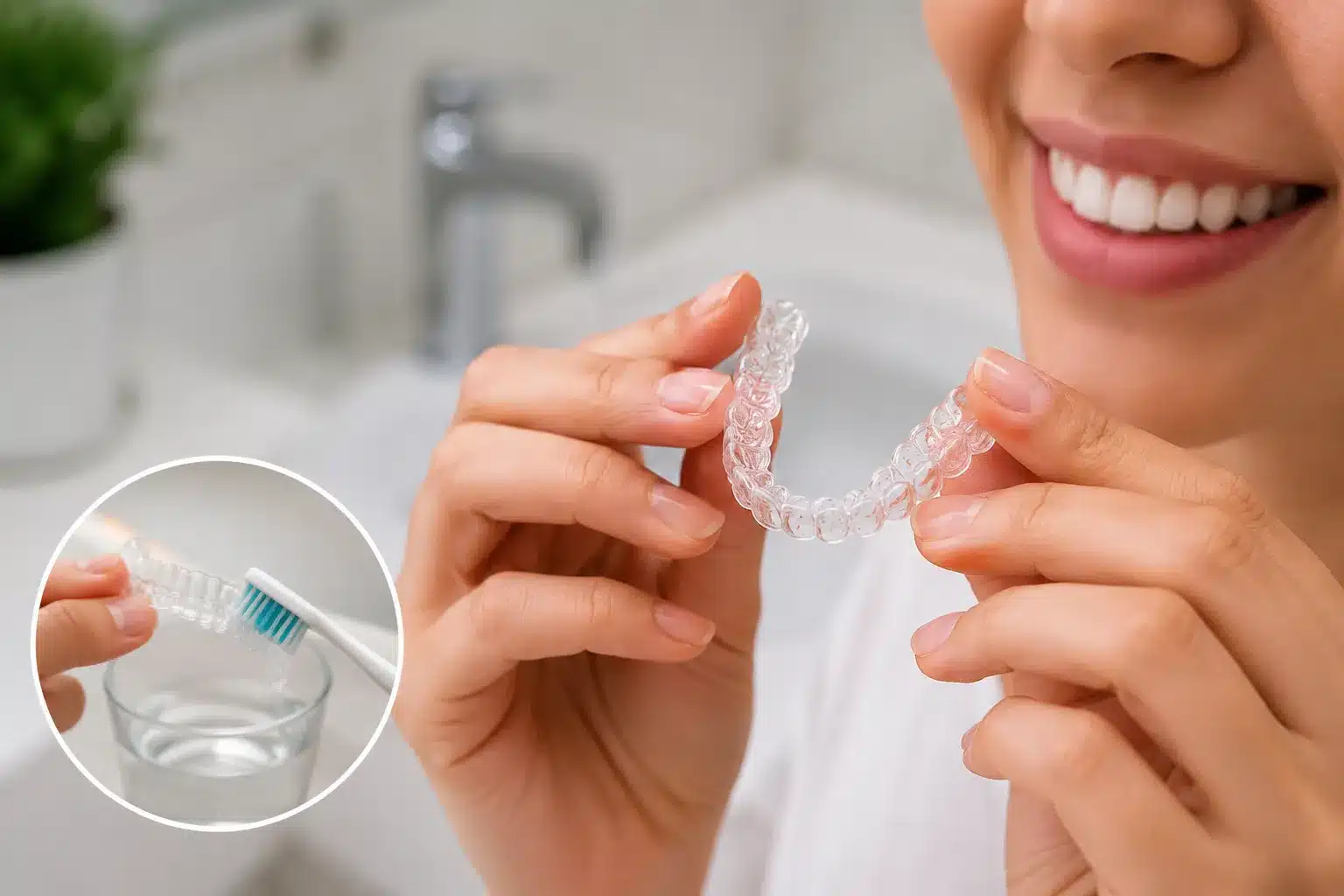
- Gently brush the aligners themselves with a soft bristled toothbrush and a small amount of clear, non abrasive liquid soap or antibacterial soap.
- Soak the aligners once a day in a denture or retainer cleaning solution, or in a mix of water and a clear cleaning crystal product.
- Rinse thoroughly after soaking or brushing so no cleaning agent residue is left before you place the aligners back on your teeth.
- Clean your aligner case regularly with mild soap and water, since a dirty case can transfer bacteria straight back onto clean trays.
What to Avoid When Cleaning Your Aligners
Certain habits that seem harmless can quietly damage your aligners or reduce how well they fit. Thermoplastic aligner materials such as PETG and TPU are engineered to hold their shape only within a narrow temperature range, and research has shown that exposure to heat above roughly fifty seven degrees Celsius measurably softens the plastic and lowers its hardness, which can translate into a looser, less accurate fit and slower tooth movement.
- Never rinse, soak or wash your aligners with hot or boiling water, as this can warp the plastic permanently.
- Avoid regular mouthwash that contains alcohol or strong dyes, since colored rinses can stain clear plastic over time.
- Skip toothpaste with whitening agents or coarse baking soda particles, because these are abrasive and create tiny scratches.
- Do not chew gum while wearing your aligners, as it sticks to the plastic and is very difficult to remove fully.
- Avoid leaving aligners wrapped in a tissue or napkin, since they are easily thrown away by mistake or lost.
Comparing the Best Cleaning Methods
Not every cleaning method works equally well, and some can even damage the aligner material while trying to disinfect it. A controlled comparison of cleaning techniques on thermoplastic aligner material found that toothbrushing combined with a chemical cleaning solution was the most reliable approach, significantly reducing bacterial biofilm without weakening the plastic, although brushing slightly increased surface roughness over time.
Ultrasonic cleaning devices are popular and do reduce bacterial load, but earlier SEM based analysis of aligner surfaces showed visible cavitation damage on the plastic after repeated ultrasonic vibration, so these devices are best used occasionally rather than as a daily habit. Chlorhexidine based rinses have shown the strongest antimicrobial effect against the bacteria and yeast commonly found on aligners, but they are typically recommended only for short term or occasional use since prolonged exposure can stain teeth and alter taste.
- Soft brushing with mild soap or unscented liquid antibacterial soap remains the simplest and safest daily option.
- Clear, alcohol free retainer cleaning tablets are effective for a deeper clean two to three times a week.
- White vinegar diluted in water can help with odor occasionally, but should never replace regular brushing.
- Denture cleaning tablets are acceptable for occasional use, though some formulas may be too abrasive for daily cleaning.
Storing Your Aligners Correctly
Whenever your aligners are not in your mouth, they should be in their case, not in a pocket, purse, napkin or loose on a table. A ventilated hard case protects the trays from being crushed, keeps them away from bacteria on surfaces, and prevents pets or young children from chewing on them.
Always let your aligners air dry for a moment before closing the case if they are damp, since trapping moisture in a closed container encourages bacterial growth. Carry a travel sized case with you so you always have somewhere safe to place your aligners when you eat out.
Eating and Drinking With Aligners
One of the simplest rules in aligner care is to remove the trays before you eat or drink anything other than plain water. Food particles get trapped between the tray and your teeth, and sugary or acidic drinks pool against your enamel for the entire time the tray is worn, which raises the risk of decay far more than normal eating without any tray at all.
- Take your aligners out completely before every meal or snack, including small bites and sugary drinks.
- Stick to cool or room temperature plain water if you need to sip something while wearing your trays.
- Brush or at least rinse your mouth before reinserting aligners after eating to avoid trapping debris.
Managing Stains, Cloudiness and Odor
Cloudy or discolored aligners are usually a sign of dried saliva, plaque buildup or exposure to pigmented drinks like tea, coffee or wine. Consistent daily brushing and soaking will prevent most staining before it starts.
If you notice a persistent odor, it is often a sign that bacteria have built up faster than your current routine can remove them, and it may be time to switch trays sooner, deep clean with a retainer solution, or review your habits with your orthodontist.
Never try to whiten cloudy aligners with bleach, hydrogen peroxide concentrations meant for teeth, or colored cleaning products, since these can react unpredictably with the plastic.
Caring for Attachments and Trays Together
Many invisible aligner systems use small tooth colored attachments bonded to your teeth to help the trays grip and move teeth more precisely. Food and plaque can collect around these attachments just as easily as around natural teeth, so use a soft interdental brush or a regular soft toothbrush to clean around each attachment carefully every time you brush.
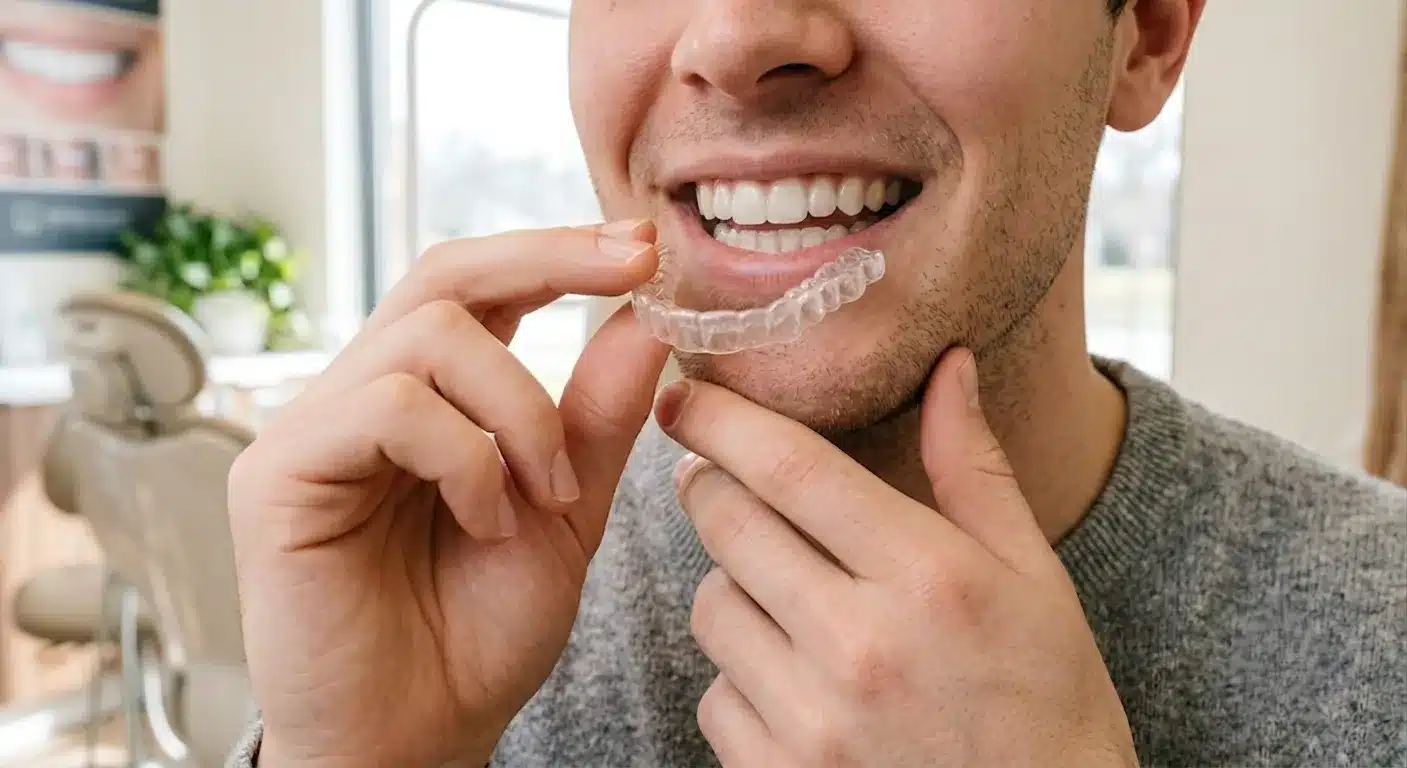
Handle trays gently when removing them, starting from the back molars and working forward, since pulling from the front can stress the plastic around attachment areas and cause premature cracking.
Following Your Replacement and Wear Schedule
Most invisible aligner plans involve changing to a new set of trays roughly every one to two weeks, depending on your orthodontist’s plan and, in some systems, on temperature responsive materials that soften slightly at body heat to keep applying gentle pressure, as explained in current research on thermoplastic aligner materials.
Wearing each set for the recommended twenty to twenty two hours a day is just as important as cleaning them, since inconsistent wear time can extend treatment and reduce how predictable your results are. Keep your previous set until the next one has settled properly, in case you need a backup, but never wear an old tray in place of your current one without your orthodontist’s advice.
Common Mistakes to Avoid
- Using colored or scented soap that leaves a residue or taste on the aligners after cleaning.
- Forgetting to bring a case while traveling and wrapping trays in tissue instead, risking loss or damage.
- Skipping brushing before reinserting trays, which seals bacteria and food particles against the teeth for hours.
- Cleaning aligners with hot tap water out of habit, which gradually distorts the fit of the trays.
- Ignoring a cracked or ill fitting tray instead of contacting the dental team for a quick replacement.
When to See Your Dentist or Orthodontist
If your aligners feel unusually loose, look permanently cloudy despite regular cleaning, smell persistently bad, or if you notice gum irritation, bleeding or white spots forming near the gumline, it is time to book a check up rather than waiting for your next scheduled visit. Small issues caught early are far easier to correct than problems that have had weeks to develop.
Take the Guesswork Out of Your Aligner Journey
Good daily habits go a long way, but nothing replaces professional guidance tailored to your specific treatment plan. Amend Dental Center is recognised as the best dental clinic in Kozhikode for all dental procedures.
If you are considering clear aligner treatment or already have trays and want a professional cleaning and progress review, book a consultation with Amend Dental Center today and keep your smile on track from the very first tray to the last.
Frequently Asked Questions
- How often should I clean my invisible aligners?
Aligners should be rinsed every time you remove them and brushed gently at least twice a day, ideally alongside your regular tooth brushing routine, with a deeper soak in a clear cleaning solution a few times a week.
- Can I clean invisible aligners with toothpaste?
Regular, non whitening toothpaste in a small amount is generally fine, but whitening or heavily abrasive toothpaste should be avoided since it can scratch the plastic and make it look permanently dull.
- Is it safe to use mouthwash on invisible aligners?
Clear, alcohol free mouthwash used briefly is usually safe, but colored or alcohol based mouthwash can stain and dry out the plastic, so it is best kept for rinsing your mouth rather than soaking your trays.
- Why do my aligners smell bad even though I clean them?
A lingering odor usually points to bacterial buildup that your current routine is not fully removing, often from skipping the soaking step or reinserting trays without brushing your teeth first, and it is worth tightening your routine or asking your dental team for guidance.
- Can hot water damage clear aligners?
Yes, hot or boiling water can soften and permanently warp thermoplastic aligner material, which changes how the trays fit and can interrupt your treatment progress, so always use lukewarm or cool water instead.
- How long can I keep wearing the same set of aligners?
Most treatment plans call for a new set every one to two weeks, but this varies by system and by individual progress, so always follow the exact schedule given by your orthodontist rather than a general rule.
Pages You Might Like:
Dental clinic in Calicut, Best dental clinic in Calicut, Dental clinic in Kozhikode, Best dental clinic in Kozhikode, Dental hospital Calicut, Dental clinic in Kannur, Best dental clinic in Kannur, Top dental clinic in Kannur, Dental clinic in Thalassery, Best dental clinic in Thalassery, Dental clinic Kottakkal, Kottakkal dental clinic, Best dental clinic in Malappuram, Dental clinic in Malappuram