Tooth decay is the most common chronic childhood disease in the world, yet it is also one of the most preventable. This guide breaks down exactly what causes cavities in children and what parents can do at every age, from the first tooth to the first molar, using guidance drawn from the American Academy of Pediatric Dentistry (AAPD), the American Dental Association (ADA) and the Centers for Disease Control and Prevention (CDC). Whether your child is a teething infant or a school-going seven-year-old, the steps below are practical, evidence-based and easy to start today.
Key Takeaways
- Clean gums before the first tooth appears and switch to fluoride toothpaste the moment a tooth erupts, using an age-appropriate amount.
- Book your child’s first dental visit by their first birthday or within six months of the first tooth, whichever happens sooner.
- Limit how often, not just how much, sugar your child eats or drinks, and never send a child to bed with a bottle of anything besides water.
- Ask about fluoride varnish and dental sealants once molars erupt, since sealants can lower cavity risk by roughly 80 per cent for two years.
- Keep six-monthly dental checkups so decay is caught while it is still small, painless and inexpensive to treat.
What Causes Tooth Decay in Children
Tooth decay in young children is formally known as early childhood caries, defined by the American Academy of Pediatric Dentistry as one or more decayed, missing or filled tooth surfaces in a child younger than six years. According to the CDC, more than half of children, about 52 per cent, have already had a cavity in their baby teeth by the age of eight. That scale is exactly why prevention matters so much in the first few years of life.
Decay develops when bacteria in the mouth, mainly a species called mutans streptococci, feed on sugar and starch left on the teeth and release acid as a byproduct. That acid slowly dissolves the outer enamel layer, and repeated acid attacks over weeks and months turn a tiny weak spot into a visible cavity. Babies are not born with these bacteria. They usually pick them up from a parent or caregiver through shared spoons, cleaning a pacifier by mouth or even kissing on the lips, which is why family oral health habits directly shape a child’s own risk.
Common Risk Factors for Early Childhood Caries
- Frequent sipping on sugary drinks such as juice, flavoured milk, soda or sports drinks.
- Falling asleep with a bottle of milk, formula or juice instead of plain water.
- Irregular or unsupervised brushing, especially skipping the bedtime brush.
- Low exposure to fluoride from toothpaste, varnish or drinking water.
- Cavity-causing bacteria passed from a parent or sibling through shared utensils.
- Limited access to routine dental care, which disproportionately affects lower-income families.
When Oral Care Should Begin
Oral care starts long before the first tooth is visible. Wipe your baby’s gums with a clean, damp, soft cloth after feedings to remove milk residue and get them used to the sensation of having their mouth cleaned. The moment the first tooth breaks through, usually between six and ten months, switch to brushing with a soft, small-headed toothbrush and a fluoride toothpaste.
The AAPD recommends establishing a dental home and scheduling your child’s first dental visit by their first birthday or within six months of the first tooth erupting, whichever comes first. An early visit lets your dentist check growth patterns, apply fluoride varnish if needed and coach you on brushing technique before small problems become bigger ones. You can book your child’s first checkup with Amend Dental Center to get this milestone started on the right track.
Brushing the Right Way, With the Right Amount of Fluoride Toothpaste
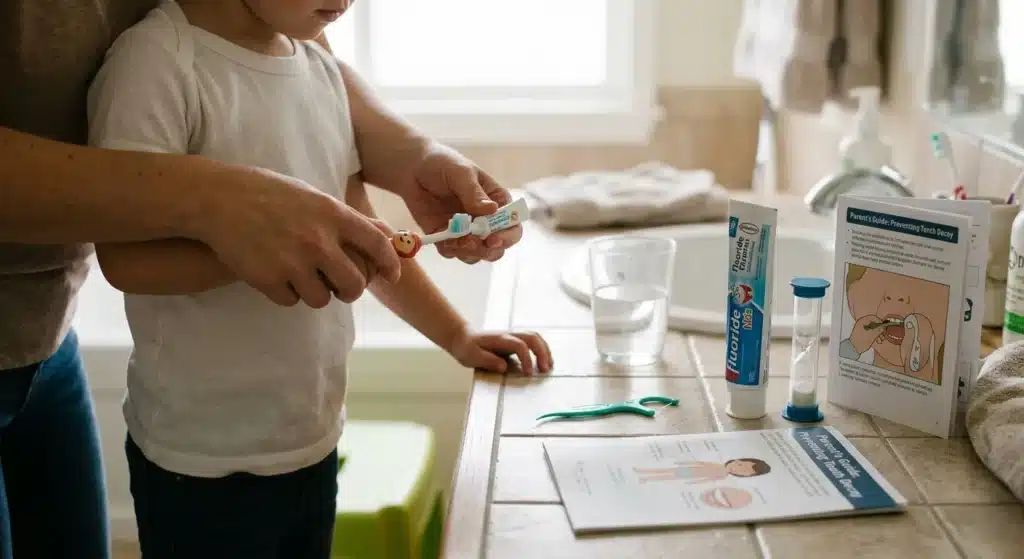
Brushing twice a day, once in the morning and once before bed, is the single most effective daily habit against cavities. The nighttime brush matters most, since saliva flow drops during sleep and leftover sugar has hours to feed bacteria undisturbed. Children lack the fine motor control to brush thoroughly on their own until around age seven or eight, so plan to brush for them or right alongside them until then.
The American Dental Association sets precise guidance on how much toothpaste to use, since swallowing too much fluoride in the early years can cause mild white marks on adult teeth called fluorosis.
- Under 3 years: use a smear of fluoride toothpaste the size of a grain of rice, twice daily.
- Ages 3 to 6: use a pea-sized amount of fluoride toothpaste and supervise so your child spits rather than swallows.
- Replace the toothbrush every three months or sooner if bristles fray or your child has been unwell.
- Choose a toothpaste carrying the ADA Seal of Acceptance for verified safety and effectiveness.
- Keep brushing time to roughly two minutes and cover every surface, including the gumline and back molars.
Diet and Sugar: Frequency Matters More Than Quantity
Every time your child eats or drinks something sugary, the bacteria on their teeth produce acid for around twenty to thirty minutes afterwards. A child who sips a sweet drink slowly across an afternoon exposes their teeth to far more acid attacks than a child who eats a dessert in one sitting and then drinks water. In other words, how often sugar touches the teeth matters more than the total amount consumed in a day.
- Never put a child to bed with a bottle or sippy cup of milk, formula or juice, since sugars pool around the teeth for hours overnight.
- Wean toddlers off the bottle by 12 to 18 months and move liquids other than water to a cup.
- Offer whole fruit instead of fruit juice, and if juice is served, limit it and dilute it with water.
- Keep sugary drinks and snacks to mealtimes rather than grazing throughout the day.
- Choose water or plain milk as the default drink between meals and after brushing at night.
- Avoid sticky, chewy sweets such as gummies or dried fruit that cling to the tooth surface for a long time.
These habits line up with the World Health Organisation’s long-standing guidance to keep free sugars under 10 per cent of daily calories, with additional benefits from staying under 5 per cent, a target that also happens to protect a child’s general metabolic health alongside their teeth.
Fluoride: A Proven Cavity Fighter
Fluoride works in two complementary ways. Topical fluoride, delivered through toothpaste, mouth rinse or a dentist-applied varnish, strengthens the enamel surface that is already present. Systemic fluoride, absorbed through fluoridated drinking water, helps build stronger enamel as teeth are still forming below the gums. Community water fluoridation is considered one of the most cost-effective public health measures on record, since it lowers cavity rates across an entire population without requiring any individual behaviour change.
For children at higher risk of decay, dentists often recommend professionally applied fluoride varnish two to four times a year in addition to brushing. This is separate from fluoride toothpaste and is quick, painless and considered safe at the doses used in dental practice. There has been recent public debate about fluoride policy, and in 2025 the ADA publicly reaffirmed its evidence based recommendations on fluoride toothpaste use for children after a state-level challenge, underscoring that used at the recommended amounts, fluoride remains both safe and effective. If you have specific concerns about fluoride for your child, discuss them with your pediatric dentist in Calicut rather than skipping fluoride altogether.
Dental Sealants: A Protective Shield for Molars
Sealants are thin, tooth coloured coatings painted onto the chewing surfaces of the back molars, where deep grooves trap food and are hard to clean with a toothbrush alone. Roughly nine out of every ten cavities in children occur in these back teeth, which is exactly where sealants offer the most protection.
According to CDC data, sealants prevent about 80 per cent of cavities for two years after they are placed and continue to protect against roughly half of cavities for up to four years, with the coating itself able to last up to nine years before it needs to be reapplied. Children without sealants develop almost three times as many cavities in their molars as children who have them, yet sealants remain underused, with less than half of children in the United States currently protected by one.
Sealants are usually placed as soon as the first permanent molars erupt, around age six, and again when the second molars come in around age twelve. The procedure takes only a few minutes per tooth, requires no drilling or anaesthesia, and is one of the best value preventive treatments in dentistry.
Regular Dental Checkups and Professional Cleaning
Even a child with excellent home habits should see a dentist every six months. Routine visits let your dentist catch decay while it is still a small, reversible white spot rather than a cavity that needs a filling, apply fluoride varnish, monitor jaw and bite development and clean away hardened plaque that a toothbrush cannot remove on its own.
Consistent checkups also build a child’s comfort with the dental chair, which pays off for a lifetime of easier visits. You can book Amend Dental Center’s pediatric dentistry services directly online.
Other Evidence-Based Dental Hygiene Tips for Kids Worth Adopting
- Avoid sharing spoons, cups or toothbrushes with your child and never clean a dropped pacifier with your own mouth, since this transfers cavity-causing bacteria.
- Start flossing as soon as two teeth touch each other, usually between ages two and three.
- Ask your dentist whether xylitol-containing gum or wipes are appropriate, since some research suggests it may reduce bacterial transmission from caregiver to child.
- Fit a mouthguard for children who play contact sports to protect teeth from injury, not just decay.
- Treat teething and reflux carefully, since frequent vomiting or acidic reflux can also erode enamel over time.
Children at Higher Risk Need Extra Attention
Some children face a higher baseline risk of early childhood caries, including those from lower-income households, children with limited access to dental care and children with certain developmental or medical conditions. A recent peer reviewed review of early childhood caries found that socioeconomic barriers and inconsistent feeding practices remain leading contributors to decay worldwide, and recommended earlier, more frequent preventive visits for these higher-risk groups. If any of these factors apply to your child, mention it at your next appointment so your dentist can adjust the recall schedule and fluoride plan accordingly.
The Takeaway
Preventing tooth decay in children is not about one single habit. It is the combination of early gum cleaning, twice daily brushing with the right amount of fluoride toothpaste, mindful snacking and drink choices, sealants on the molars and a dental visit every six months that keeps a child’s smile cavity-free. Start as early as possible, stay consistent, and let your dentist catch anything small before it becomes a bigger, more painful problem.
If you are ready to put these steps into practice, book your child’s appointment with Amend Dental Center today and give your child’s smile the preventive care it deserves, backed by a team that follows ADA and AAPD guidelines at every visit.
Frequently Asked Questions
At what age should my child first see a dentist?
Schedule your child’s first dental appointment no later than their first birthday, or within six months of the eruption of their first tooth. This early visit establishes a dental home and lets your dentist catch problems while they are still easy to manage.
What is the right amount of toothpaste for a toddler?
Use a smear of fluoride toothpaste the size of a grain of rice for children under three, and a pea sized amount for children aged three to six, brushing twice a day and supervising so they spit rather than swallow.
Are dental sealants safe and worth getting for kids?
Yes. Sealants are a quick, painless coating painted on the molars and are considered one of the safest, most cost-effective ways to prevent cavities, cutting decay risk in the back teeth by around 80 percent for the first two years.
Can cavities in baby teeth affect a child’s permanent teeth?
Yes. Untreated decay in baby teeth can spread infection to the gum and bone below, damage the permanent tooth developing underneath and increase the likelihood of decay in adult teeth later on.
Is fluoride toothpaste safe for young children?
Fluoride toothpaste is safe and effective when used in the amounts recommended for each age group. The main risk of using too much at a young age is mild fluorosis, which is a cosmetic change in tooth appearance, not a health hazard, and is avoided by sticking to the rice grain and pea sized guidelines.
How often should my child visit the dentist?
Most children should visit a Dental clinic in Calicut every six months, though your dentist may recommend more frequent visits if your child has a higher risk of decay or ongoing dental work to monitor.
Pages You Might Like:
Dental clinic in Calicut, Best dental clinic in Calicut, Dental clinic in Kozhikode, Best dental clinic in Kozhikode, Dental hospital Calicut, Dental clinic in Kannur, Best dental clinic in Kannur, Top dental clinic in Kannur, Dental clinic in Thalassery, Best dental clinic in Thalassery, Dental clinic Kottakkal, Kottakkal dental clinic, Best dental clinic in Malappuram, Dental clinic in Malappuram